scRNA-seq 
 

Here, you’ll learn how to manage a growing number of scRNA-seq datasets as a single queryable collection:
create a dataset (an
Artifact) and seed aCollection()
append a new dataset to the collection (
)
query & analyze individual datasets (
)
load the collection into memory (
)
iterate over the collection to train an ML model (
)
concatenate the collection to a single
tiledbsomaarray store ()
If you’re only interested in using a large curated scRNA-seq collection, see the CELLxGENE guide.
# pip install lamindb
lamin init --storage ./test-scrna --modules bionty
Show code cell output
→ set dev-dir: /home/runner/work/lamin-usecases/lamin-usecases/docs
→ initialized lamindb: testuser1/test-scrna
import lamindb as ln
import bionty as bt

ln.track()
Show code cell output
→ connected lamindb: testuser1/test-scrna
→ created Transform('iPJMJCU1yUYu0000', key='scrna.ipynb'), started new Run('8boS3ZqmC8sHmxED') at 2026-09-11 14:44:50 UTC
→ notebook imports: bionty==2.4.3 lamindb-core==2.9.1
• tip: to identify the notebook across renames, pass the uid: ln.track("iPJMJCU1yUYu")
Populate metadata registries based on an artifact
Let us look at the standardized data of Conde et al., Science (2022), available from CELLxGENE. anndata_human_immune_cells() loads a subsampled version:
adata = ln.core.datasets.anndata_human_immune_cells()
adata
Show code cell output
AnnData object with n_obs × n_vars = 1648 × 36503
    obs: 'donor', 'tissue', 'cell_type', 'assay'
    var: 'feature_is_filtered', 'feature_reference', 'feature_biotype'
    uns: 'default_embedding'
    obsm: 'X_umap'
To validate & annotate a dataset, we need to define valid features.
ln.Feature(name="donor", dtype=str).save()
ln.Feature(name="tissue", dtype=bt.Tissue).save()
ln.Feature(name="cell_type", dtype=bt.CellType).save()
ln.Feature(name="assay", dtype=bt.ExperimentalFactor).save()
Show code cell output
! tip: pass `type` to map feature into a type hierarchy
! tip: pass `type` to map feature into a type hierarchy
! tip: pass `type` to map feature into a type hierarchy
! tip: pass `type` to map feature into a type hierarchy
Feature(uid='zIimY8HphtDC', is_type=False, name='assay', _dtype_str='cat[bionty.ExperimentalFactor]', unit=None, description=None, array_rank=0, array_size=0, array_shape=None, synonyms=None, default_value=None, nullable=True, coerce=None, branch_id=1, created_on_id=1, space_id=1, created_by_id=1, run_id=1, type_id=None, created_at=2026-09-11 14:44:53 UTC, is_locked=False)
Let’s attempt saving this dataset as a validated & annotated artifact.
try:
    artifact = ln.Artifact.from_anndata(
        adata, schema="ensembl_gene_ids_and_valid_features_in_obs"
    ).save()
except ln.errors.ValidationError:
    pass
Show code cell output
! tip: pass `type` to map schema into a type hierarchy
! tip: pass `type` to map schema into a type hierarchy
! tip: pass `type` to map schema into a type hierarchy
→ loading artifact into memory for validation
One cell type isn’t validated because it’s not part of the CellType registry. Let’s create it.
adata.obs["cell_type"] = bt.CellType.standardize(adata.obs["cell_type"])
bt.CellType(name="animal cell").save()
Show code cell output
CellType(uid='2Go5sf8V9UYpwB', name='animal cell', ontology_id=None, abbr=None, synonyms=None, description=None, branch_id=1, created_on_id=1, space_id=1, created_by_id=1, run_id=1, source_id=None, created_at=2026-09-11 14:45:00 UTC, is_locked=False)
We can now save the dataset.
# runs ~10sec because it imports 40k Ensembl gene IDs from a public ontology
artifact = ln.Artifact.from_anndata(
    adata,
    key="datasets/conde22.h5ad",
    schema="ensembl_gene_ids_and_valid_features_in_obs",
).save()
Show code cell output
→ loading artifact into memory for validation
→ starting creation of 35459 Gene records in batches of 10000
→ not annotating with 35459 features for slot var.T as it exceeds 1000 (ln.settings.annotation.n_max_records)
Some Ensembl gene IDs don’t validate because they stem from an older version of Ensembl. If we wanted to be 100% sure that all gene identifiers are valid Ensembl IDs you can import the genes from an old Ensembl version into the Gene registry (see guide). One can also enforce this through the .var.T schema by setting schema.maximal_set=True, which will prohibit any non-valid features in the dataframe.
artifact.describe()
Show code cell output
Artifact: datasets/conde22.h5ad (0000)
├── uid: yc44Igcg63vjpdN30000            run: 8boS3Zq (scrna.ipynb)
│   kind: dataset                        otype: AnnData
│   hash: oHb_G_zCRDhZTJpW_Z5_sm         size: 54.9 MB
│   branch: main                         space: all
│   created_at: 2026-09-11 14:45:23 UTC  created_by: testuser1
│   n_observations: 1648                 schema: anndata_ensembl_gene_ids_and_valid_features_in_obs
├── storage/path:
│   /home/runner/work/lamin-usecases/lamin-usecases/docs/test-scrna/.lamindb/yc44Igcg63vjpdN30000.h5ad
├── Dataset features
│   ├── obs (4)
│   │   assay                          bionty.ExperimentalFactor            10x 3' v3, 10x 5' v1, 10x 5' v2
│   │   cell_type                      bionty.CellType                      CD16-negative, CD56-bright natural kil…
│   │   donor                          str
│   │   tissue                         bionty.Tissue                        blood, bone marrow, caecum, duodenum, …
│   └── var.T (35459 bionty.Gene.ens…
└── Labels
    └── .tissues                       bionty.Tissue                        blood, thoracic lymph node, spleen, lu…
        .cell_types                    bionty.CellType                      classical monocyte, T follicular helpe…
        .experimental_factors          bionty.ExperimentalFactor            10x 3' v3, 10x 5' v2, 10x 5' v1
Seed a collection
Let’s create a first version of a collection that will encompass many h5ad files when more data is ingested.
Note
To see the result of the incremental growth, take a look at the CELLxGENE Census guide for an instance with ~1k h5ads and ~50 million cells.
collection = ln.Collection(artifact, key="scrna/collection1").save()
For this version 1 of the collection, collection and artifact match each other. But they’re independently tracked and queryable through their registries:
collection.describe()
Show code cell output
Collection: scrna/collection1 (0000)
└── uid: YJPLPPZxTdATehep0000            run: 8boS3Zq (scrna.ipynb)
    branch: main                         space: all
    created_at: 2026-09-11 14:45:23 UTC  created_by: testuser1
Access the underlying artifacts like so:
collection.artifacts.to_dataframe()
Show code cell output
| uid | key | description | suffix | kind | otype | size | hash | n_files | n_observations | ... | is_latest | is_locked | created_at | branch_id | created_on_id | space_id | storage_id | run_id | schema_id | created_by_id | |
|---|---|---|---|---|---|---|---|---|---|---|---|---|---|---|---|---|---|---|---|---|---|
| id | |||||||||||||||||||||
| 1 | yc44Igcg63vjpdN30000 | datasets/conde22.h5ad | None | .h5ad | dataset | AnnData | 57612943 | oHb_G_zCRDhZTJpW_Z5_sm | None | 1648 | ... | True | False | 2026-09-11 14:45:23.540000+00:00 | 1 | 1 | 1 | 1 | 1 | 3 | 1 |
1 rows × 22 columns
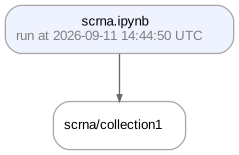
See data lineage:
collection.view_lineage()
Show code cell output
Finish the run and save the notebook.
ln.finish()
Show code cell output
→ finished Run('8boS3ZqmC8sHmxED') after 34s at 2026-09-11 14:45:25 UTC